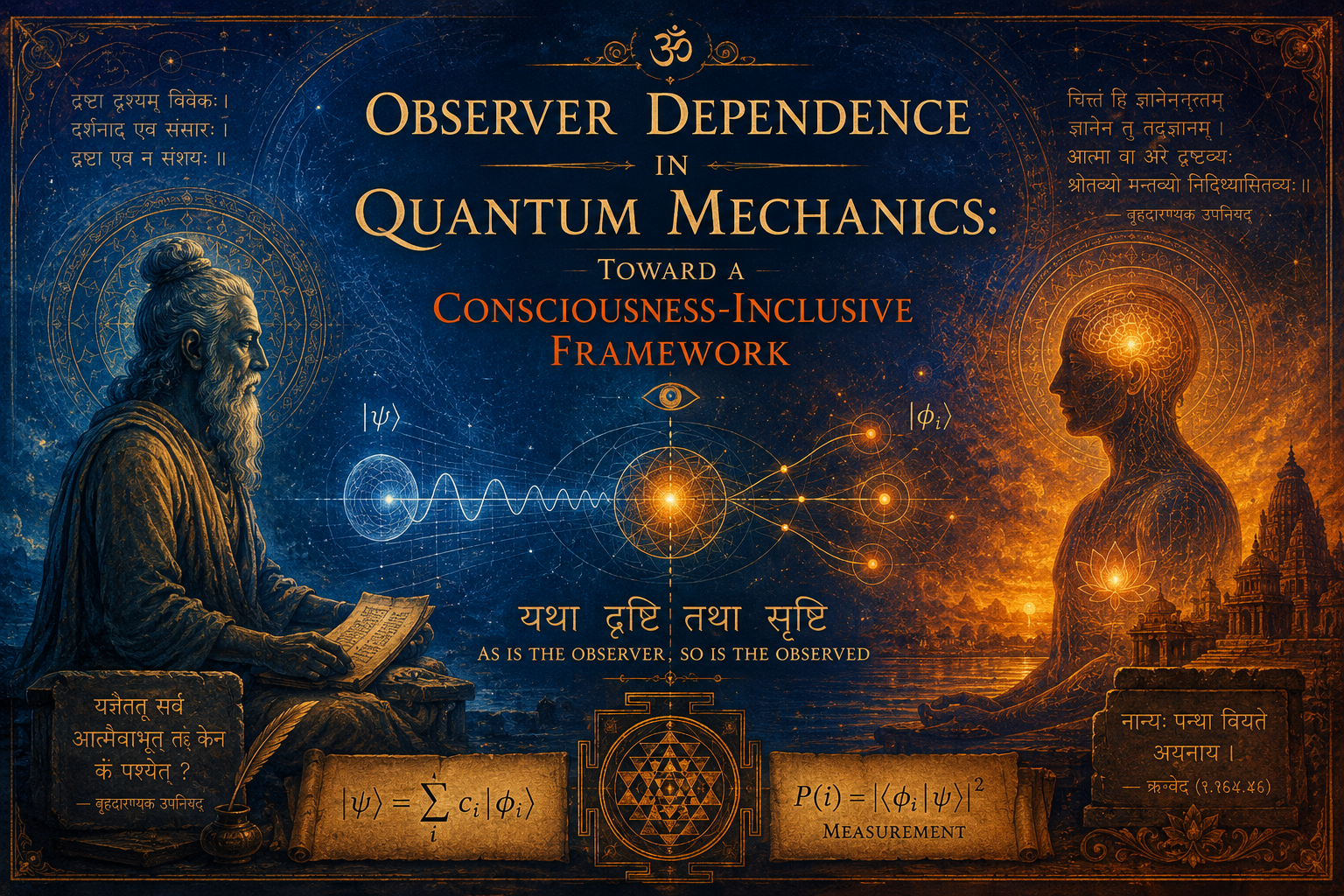
Quantum mechanics challenges the classical assumption of an observer-independent reality, introducing phenomena such as superposition, entanglement, and measurement-induced state reduction. Parallel to this, the Vedic doctrine of Achintya Bhedābheda (inconceivable simultaneous oneness and difference) offers a philosophical framework in which unity and multiplicity coexist through consciousness. This paper develops a rigorous comparative framework between quantum theory and Vedic philosophy, arguing for a relational ontology in which observer and observed are fundamentally intertwined. By analyzing major interpretations of quantum mechanics—including Copenhagen and Many-Worlds—alongside primary Sanskrit sources from the Upaniṣads, Bhagavad Gītā, and Bhāgavata Purāṇa, this study proposes a consciousness-inclusive paradigm that extends beyond current physicalist models.
- Introduction
The Newtonian worldview posits a reality that exists independently of observation. However, quantum mechanics disrupts this assumption. The mathematical formalism of quantum theory suggests that physical systems are described by a wavefunction Ψ, which encodes probabilities rather than definite properties:
Ψ(x,t)
Upon measurement, this wavefunction appears to collapse into a definite state, raising foundational questions: What constitutes a measurement? Does consciousness play a role?
Ancient vedic philosophical traditions, particularly Achintya Bhedābheda expressed in the Gauḍīya Vaiṣṇava tradition, offer a metaphysical perspective where reality is simultaneously unified and differentiated. This framework provides conceptual clarity to interpret quantum puzzles.
- Mathematical Foundations of Quantum Observation
The Schrödinger equation governs the evolution of a quantum system:
iħ ∂Ψ/∂t = ĤΨ
Where:
- Ψ is the wavefunction
- Ĥ is the Hamiltonian operator
Measurement introduces discontinuity, often modeled as:
Ψ → |ψ_i⟩ with probability |⟨ψ_i|Ψ⟩|²
This non-deterministic collapse suggests that observation is not merely passive but participatory.
- Interpretations of Quantum Mechanics
3.1 Copenhagen Interpretation
The Copenhagen interpretation (Bohr, Heisenberg) asserts that physical systems do not possess definite properties until measured. Reality is fundamentally probabilistic, and the observer plays a crucial role in actualizing outcomes.
Key implication: Reality is not fully objective.
3.2 Many-Worlds Interpretation
The Many-Worlds interpretation (Everett) removes wavefunction collapse entirely. Instead, all possible outcomes occur in branching universes:
|Ψ⟩ = Σ c_i |ψ_i⟩
Each term corresponds to a distinct world.
Key implication: Reality is fully deterministic but multiplicative.
3.3 Relational Quantum Mechanics
Relational interpretations propose that states are relative to observers. There is no absolute state, only relational properties.
- Consciousness and Observer-Dependence
The Vedic epistemological principle that perception is conditioned by consciousness is succinctly expressed in the Sanskrit maxim:
“यथा दृष्टिः तथा सृष्टिः”
(yathā dṛṣṭiḥ tathā sṛṣṭiḥ)
“As is one’s perception, so is one’s experienced reality.”
This idea finds deeper scriptural grounding in primary texts:
भगवद्गीता ४.११
ये यथा मां प्रपद्यन्ते तांस्तथैव भजाम्यहम् ।
(ye yathā māṁ prapadyante tāṁs tathaiva bhajāmy aham)
“As people approach Me, I reciprocate with them accordingly.”
This verse establishes a profound relational principle: the ultimate reality (Bhagavān) is experienced differently depending on the consciousness and disposition of the observer.
श्रीमद्भागवतम् १०.४३.१७
मल्लानामशनिर्नृणां नरवरः स्त्रीणां स्मरो मूर्तिमान् ।
गोपानां स्वजनोऽसतां क्षितिभुजां शास्ता स्वपित्रोः शिशुः ॥
“To the wrestlers He appeared like a thunderbolt; to ordinary men, the best of humans; to women, the embodiment of Cupid; to the cowherds, their relative; to the wicked kings, a punisher; to His parents, a child.”
This verse is particularly significant: the same objective reality—Śrī Kṛṣṇa—is perceived in radically different ways depending on the observer’s inner state, role, and consciousness.
Vedic Illustrations of Observer-Conditioned Reality
- Duryodhana perceived Kṛṣṇa as a political adversary and existential threat (akin to Yamarāja, the force of inevitable destruction).
- Bhīṣma perceived Him as the Supreme Lord and offered devotional prayers.
- Vidura recognized Him as the परमात्मा (Paramātmā), the indwelling consciousness.
- The gopīs experienced Him as the highest object of divine love (prema).
Similarly, in the Viśvarūpa Darśana (Bhagavad Gītā, Chapter 11), Arjuna perceives the universal form only after being granted divya cakṣu (divine vision), while others remain unable to perceive it—demonstrating that perception depends on the level of consciousness.
Quantum Formalism and Observer-System Relation
In quantum mechanics, this observer-dependence can be formally expressed through entanglement:
\n|Ψ⟩ = Σ cᵢ |observerᵢ⟩ ⊗ |systemᵢ⟩\n
This indicates that observer and system form a correlated whole. The state of the system cannot be fully described independently of the observer interacting with it.
Synthesis
Both quantum theory and Vedic philosophy converge on a shared insight:
- The observer and observed are fundamentally interrelated.
- Perception is conditioned by consciousness.
- Reality is relational rather than purely objective.
Thus, what is “seen” is not merely a property of the object, but a function of the observer–consciousness interaction.
- Achintya Bhedābheda: Ontological Framework
Achintya Bhedābheda posits that reality is simultaneously one and different. This is neither strict monism (Advaita) nor dualism (Dvaita), but a synthesis.
Bhagavad Gītā (9.4):
मया ततमिदं सर्वं जगदव्यक्तमूर्तिना । मत्स्थानि सर्वभूतानि न चाहं तेष्ववस्थितः ॥
Translation: “By Me, in My unmanifest form, this entire universe is pervaded. All beings are in Me, but I am not in them.”
This expresses simultaneous unity and distinction.
Īśa Upaniṣad (Mantra 1):
ईशावास्यमिदं सर्वं यत्किञ्च जगत्यां जगत् ।
“All this—whatever exists in this changing universe—is pervaded by the Divine.”
Śrīmad Bhāgavatam (1.2.11):
वदन्ति तत् तत्त्वविदस् तत्त्वं यज्ज्ञानमद्वयम् । ब्रह्मेति परमात्मेति भगवानिति शब्द्यते ॥
Reality is understood in three aspects: Brahman, Paramātman, Bhagavān—indicating unity with diversity.
- Interconnected Reality: Quantum and Vedic Parallels
6.1 Quantum Entanglement
Entangled systems exhibit correlations regardless of spatial separation:
|Ψ⟩ = (1/√2)(|00⟩ + |11⟩)
Measurement of one immediately determines the other.
6.2 Vedic Interconnectedness
Vedic cosmology maintains that all beings are intrinsically interconnected through Brahman, the universal consciousness underlying existence. The apparent separateness among individuals and objects is not absolute reality but a phenomenological manifestation arising from limited perception (māyā and conditioned consciousness). At the deepest ontological level, existence is unified.
This principle is clearly articulated in the Bhagavad Gītā (15.7):
ममैवांशो जीवलोके जीवभूतः सनातनः ।
मनःषष्ठानीन्द्रियाणि प्रकृतिस्थानि कर्षति ॥
“The eternal living beings in this conditioned world are verily My fragments (parts). Bound by material nature, they struggle with the six senses including the mind.”
This verse is central to the philosophy of interconnectedness. The term “mama eva aṁśaḥ” (“verily My own part”) indicates that every conscious being (jīva) is not independent of the Supreme Reality but participates in it as an inseparable expression of the divine consciousness.
From the standpoint of Achintya Bhedābheda:
- The individual soul is simultaneously one with and different from the Supreme.
- Unity exists at the level of consciousness.
- Difference exists at the level of individuality and experiential manifestation.
Thus, separation is functional rather than absolute.
This ontological structure bears striking conceptual similarity to quantum interconnectedness. In quantum entanglement, particles that have interacted cannot be completely described independently of one another, even across vast distances. Likewise, Vedic philosophy asserts that all beings remain connected through Brahman regardless of apparent material separation.
The Chāndogya Upaniṣad further reinforces this non-separability through the mahāvākya:
सर्वं खल्विदं ब्रह्म—“Verily, all this is Brahman.”
Similarly, the Īśa Upaniṣad declares:
ईशावास्यमिदं सर्वं यत्किञ्च जगत्यां जगत् ।—“All this—whatever exists in this universe—is pervaded by the Divine.”
These declarations suggest that multiplicity emerges within an underlying unity rather than existing independently of it.
In experiential terms, Vedic interconnectedness implies:
- Consciousness is fundamental rather than emergent.
- Individual beings are localized expressions of a universal conscious field.
- Reality is relational and participatory.
- The observer and the observed arise within the same ontological continuum.
This perspective extends beyond material reductionism by proposing that consciousness is not produced by matter; rather, matter itself exists within consciousness.
A useful comparative formulation may therefore be expressed as:
Reality=Unity (Brahman)+Manifest Multiplicity (Jagat and Jıˉva)Reality = Unity\,(Brahman) + Manifest\,Multiplicity\,(Jagat\,and\,Jīva)Reality=Unity(Brahman)+ManifestMultiplicity(JagatandJıˉva)
Within this framework, individuality does not negate unity, just as wave-particle duality does not negate the underlying quantum nature of matter. The universe becomes an interconnected conscious whole in which apparent separation is contextual, not ultimate.
Parallel insight:
- Quantum: Non-local correlations
- Vedic: Universal consciousness
- Beyond Objective vs Subjective Reality
The traditional distinction between objective reality and subjective experience becomes increasingly inadequate under both quantum mechanics and Vedic metaphysics. Classical physics assumes that reality exists independently of the observer, while subjective experience is treated as secondary or illusory. However, both quantum theory and the philosophy of Achintya Bhedābheda challenge this separation.
In quantum mechanics, the observer cannot be completely detached from the observed system. Measurement alters the state of the system, implying that reality is not merely “out there” independent of interaction. Similarly, Vedic philosophy maintains that the world is experienced through consciousness and that perception itself participates in the manifestation of reality.
Thus, reality is neither purely objective nor merely subjective; rather, it is relational.
A relational ontology may therefore be expressed as:
Reality=f(observer, system, consciousness)Reality = f(observer,\ system,\ consciousness)Reality=f(observer, system, consciousness)
Where:
- Observer influences the act of measurement and interpretation.
- System provides the probabilistic and structural basis of manifestation.
- Consciousness serves as the underlying field within which both observer and system arise.
In this framework, reality emerges through interaction rather than existing as an isolated independent entity. The observer does not passively discover reality but actively participates in its experiential manifestation.
This view parallels the Vedic conception expressed in the Bhagavad Gītā (13.27):
समं सर्वेषु भूतेषु तिष्ठन्तं परमेश्वरम् ।
विनश्यत्स्वविनश्यन्तं यः पश्यति स पश्यति ॥
(samaṁ sarveṣu bhūteṣu tiṣṭhantaṁ parameśvaram vinaśyatsv avinaśyantaṁ yaḥ paśyati sa paśyati)
—“One truly sees who perceives the Supreme existing equally within all beings.”
The verse suggests that true perception arises not from fragmented observation but from recognizing the interconnected conscious principle underlying multiplicity.
Similarly, Achintya Bhedābheda resolves the tension between unity and diversity by affirming that reality is simultaneously:
- One, because all existence is grounded in Brahman.
- Different, because individual observers experience reality through distinct states of consciousness.
This model also resonates with relational interpretations of quantum mechanics, where physical properties are not absolute but emerge through relationships between systems and observers.
Thus:
- Objectivity without consciousness is incomplete.
- Subjectivity without external structure is insufficient.
- Reality is fundamentally participatory and relational.
The universe, therefore, may be understood not as a collection of isolated objects, but as an interconnected network of consciousness, observation, and manifestation.
- Toward a Consciousness-Inclusive Physics
Modern physics has achieved extraordinary success in describing the behavior of matter and energy, yet it remains incomplete in addressing the role of consciousness. In standard physical models, consciousness is generally treated as an emergent byproduct of neural activity rather than as a fundamental component of reality. However, quantum mechanics introduces phenomena that challenge this exclusion, particularly in relation to measurement, observation, and the collapse of probabilistic states into definite outcomes.
The unresolved measurement problem demonstrates the limitations of purely materialist interpretations. While the Schrödinger equation describes continuous deterministic evolution:
iℏ∂Ψ∂t=H^Ψi\hbar \frac{\partial \Psi}{\partial t}=\hat{H}\Psiiℏ∂t∂Ψ=H^Ψ
the act of measurement appears to introduce discontinuity, where multiple possibilities reduce into a single observed actuality. The theory itself does not clearly explain why or how this transition occurs.
A consciousness-inclusive framework proposes that observation is not merely a physical interaction but involves awareness as a constitutive element of reality.
Such a framework could contribute to physics in several ways:
8.1 Resolving the Measurement Problem
Quantum systems evolve as superpositions of possibilities until measurement occurs. Classical interpretations struggle to explain why a specific outcome emerges from many probabilities.
A consciousness-centered interpretation suggests that conscious observation participates in the actualization of potential states. Rather than viewing consciousness as external to physics, it becomes part of the ontological structure of measurement itself.
This does not necessarily imply that human thought “creates” reality arbitrarily; rather, it proposes that consciousness is intrinsically linked to the manifestation of definite experiential states.
8.2 Explaining Observer-Dependence
Quantum experiments reveal that outcomes depend on observational arrangements. The observer is not fully separable from the observed system.
This relational structure parallels Vedic insights that perception depends on the state of consciousness. Different observers encounter the same reality differently because consciousness conditions experience.
The Bhagavad Gītā (4.11) expresses this principle:
ये यथा मां प्रपद्यन्ते तांस्तथैव भजाम्यहम् ।
(ye yathā māṁ prapadyante tāṁs tathaiva bhajāmy aham)
—“As beings approach Me, I reciprocate accordingly.”
Reality is thus relational rather than purely objective.
8.3 Bridging Physics and Phenomenology
Modern science excels in describing external structures but struggles to explain subjective experience (qualia), self-awareness, and intentionality.
Phenomenology studies conscious experience from the first-person perspective, while physics traditionally examines third-person measurable phenomena. A consciousness-inclusive physics would bridge these domains by recognizing consciousness as fundamental rather than secondary.
This integration could establish a unified framework where:
- Physical processes describe external manifestation.
- Consciousness describes experiential reality.
- Both emerge from a deeper ontological unity.
Achintya Bhedābheda as a Foundational Framework
The Vedic doctrine of Achintya Bhedābheda offers a sophisticated metaphysical model capable of supporting such an integration.
The term means:
- Bheda — difference
- Abheda — non-difference
- Achintya — inconceivable simultaneously
Reality is therefore understood as simultaneously unified and differentiated.
8.4 Ontological Flexibility
Unlike rigid dualism or strict monism, Achintya Bhedābheda accommodates paradox without contradiction.
- Consciousness and matter are distinct yet interconnected.
- Individual beings are separate yet inseparable from Brahman.
- Observer and observed are relationally dependent.
This flexibility aligns remarkably with quantum complementarity, where entities exhibit apparently contradictory properties such as wave and particle behavior.
8.5 A Non-Reductionist Framework
Reductionist materialism attempts to explain consciousness entirely through physical processes. However, consciousness possesses qualities—self-awareness, intentionality, subjective experience—that resist purely mechanistic explanation.
Achintya Bhedābheda avoids this limitation by treating consciousness as ontologically fundamental.
The Kaṭha Upaniṣad states:
नित्यो नित्यानां चेतनश्चेतनानाम् ।
(nityo nityānāṁ cetanaś cetanānām)
—“Among all eternal beings, there is one supreme eternal consciousness.”
This implies that consciousness is not accidental but foundational to existence itself.
8.6 Integration of Unity and Multiplicity
One of the greatest challenges in both physics and philosophy is explaining how multiplicity emerges from underlying unity.
Quantum field theory suggests that diverse particles arise from deeper unified fields. Similarly, Vedic philosophy maintains that the universe manifests from Brahman while remaining non-separate from it.
This relationship can be conceptually expressed as:
Brahman→Consciousness→Manifest RealityBrahman \rightarrow Consciousness \rightarrow Manifest\,RealityBrahman→Consciousness→ManifestReality
Multiplicity is therefore real at the experiential level but grounded in an underlying unity.
Toward a New Scientific Paradigm
A consciousness-inclusive physics does not reject empirical science; rather, it extends its scope. It proposes that consciousness should be considered a foundational variable in understanding reality.
Such a paradigm could:
- Reconcile observer and observed
- Integrate subjective and objective domains
- Bridge science and spirituality
- Provide new approaches to cognition, cosmology, and quantum theory
Within this framework, the universe is not a dead mechanical system but a dynamic, interconnected field of consciousness and manifestation.
The philosophy of Achintya Bhedābheda offers a powerful conceptual foundation for this emerging synthesis by affirming that reality is simultaneously:
- One and many
- Objective and experiential
- Material and conscious
Thus, the future of foundational physics may require not merely better equations, but a deeper understanding of consciousness itself.
10. Conclusion
Quantum mechanics has fundamentally challenged the classical assumption of an observer-independent reality. Phenomena such as wave–particle duality, superposition, entanglement, and the measurement problem reveal that the observer cannot be completely separated from the observed system. Reality, at the quantum level, appears not as a collection of independently existing objects but as a network of relationships whose manifestation depends upon observation and interaction.
At the same time, the Vedic doctrine of Achintya Bhedābheda provides a profound metaphysical framework for understanding this relational nature of existence. By affirming the simultaneous and inconceivable unity and diversity of reality, it transcends the limitations of both strict dualism and absolute monism. According to this view, all beings are interconnected through a common foundation of consciousness while retaining their individual identities. The apparent separateness of the world is therefore relative rather than ultimate.
The comparative analysis presented in this study suggests that both quantum theory and Vedic philosophy converge on several foundational insights:
- Reality is relational rather than entirely objective.
- The observer plays a constitutive role in the manifestation of experience.
- Consciousness cannot be dismissed as merely an epiphenomenon of matter.
- Unity and multiplicity coexist as complementary aspects of existence.
- The observer and observed emerge within a deeper interconnected framework.
The Bhagavad Gītā declaration,
ममैवांशो जीवलोके जीवभूतः सनातनः ।
(mamaivāṁśo jīvaloke jīvabhūtaḥ sanātanaḥ)
—“The living beings in this world are My eternal parts” (Gītā 15.7),
Encapsulates the central thesis of interconnected reality: individual consciousness is neither wholly independent nor completely identical with the ultimate reality. This principle mirrors, at a metaphysical level, the quantum insight that apparently separate entities may remain fundamentally connected.
While quantum mechanics does not presently establish consciousness as a causal agent in measurement, it undeniably raises questions that transcend purely material explanations. The Vedic perspective offers a broader ontological framework in which consciousness is not an accidental product of matter but a fundamental dimension of reality itself.
Therefore we propose that a future science of consciousness may require moving beyond the conventional objective–subjective divide toward a participatory ontology, wherein observer, observed, and consciousness form an inseparable triad. Such a framework would not replace empirical science but extend it, integrating first-person experience with third-person observation within a unified understanding of existence.
Future research should focus on:
- Developing rigorous theoretical models that incorporate consciousness into physical descriptions of reality.
- Exploring possible connections between quantum information, cognition, and conscious experience.
- Investigating the philosophical implications of observer-dependence through comparative studies of physics and contemplative traditions.
- Formulating experimentally testable hypotheses concerning consciousness and measurement.
- Constructing an interdisciplinary framework that integrates physics, neuroscience, philosophy, and Vedic metaphysics.
Ultimately, the dialogue between quantum mechanics and Achintya Bhedābheda is not merely a comparison between modern science and ancient wisdom. Rather, it represents an emerging inquiry into one of humanity’s deepest questions: What is the relationship between consciousness and reality? If consciousness is indeed fundamental, then understanding it may be as crucial to the future of physics as understanding space, time, matter, and energy. In this sense, the quest for a consciousness-inclusive science may constitute the next major paradigm shift in our understanding of the cosmos and our place within it.
References
- Bohr, N. (1935). Can Quantum-Mechanical Description of Physical Reality be Considered Complete?
- Everett, H. (1957). Relative State Formulation of Quantum Mechanics.
- Brahmacari, D. S. K. D. (2024). Quantum consciousness: Bridging science and spirituality through Vedic philosophy. Available at SSRN 4843445.
- Heisenberg, W. (1958). Physics and Philosophy.
- Bhagavad Gītā
- Īśa Upaniṣad
- Brahmacari, D. S. K. D. (2024). Matter and consciousness in Achintya Bhedābheda: Bridging with quantum physics. Available at SSRN 4860519.
- Śrīmad Bhāgavatam
- Chaitanya Charitamrita
- Brahmacari, D. S. K. D. (2024). String Theory as Mentioned in Veda. Available at SSRN 4967100.
- Penrose, R. (1994). Shadows of the Mind.
- Wheeler, J.A. (Participatory Universe concept)
- Brahmacari, D. S. K. D. (2024). Perception of Quantum Gravity and Field Theory in the Vedas. Available at SSRN 4985820.
- Brahmacari, Dr. Srivas Krishna Das, Quantum Consciousness: Exploring Matter, Mechanics, and Interconnectedness in Vedic Texts (August 08, 2024)
- Brahmacari, D. S. K. D. (2023). A Comprehensive Study on the Theory of Relativity, as revealed in Vedic Literature. Available at SSRN 4774176.
- Brahmacari, S. K. D. (2024). Understanding the Space Time Continuum-As revealed in Vedic literature: A Comprehensive study on the Theory of Relativity-As revealed in Vedic literature. JF Inc..
Views: 90
















Origin of Science
The Psychospiritual Roots of Crime
Unveiling 54 Vedic Scientists
The Existence of the Soul: Exploring Neuroscience, Quantum Physics and Vedic Philosophy
Temporal Relativity in Vedic Literature: An Interdisciplinary Analysis of Time Dilation Narratives
Acharya Kaṇāda: The Ancient Sage Who Discovered the Atom
Evidence of Vedic Sanātana Hinduism as a Global Dharma
Perception of Quantum Gravity and Field Theory in the Vedas
String Theory as Mentioned in Veda
Sanskrit’s Role in Advancing AI: A Comprehensive Study
The Vedic Model of the Mind: A Contemporary Exploration
Vedic Contributions to Geometry: Unveiling the Origins of Mathematics
Matter and Consciousness in Achintya Bhedābheda: Bridging with Quantum Physics